No control over access
People sign up for AI tools on their own, share provider keys between teams, and build assistants on personal accounts with company documents. Nobody can say who has access to what, or take it back when someone leaves.
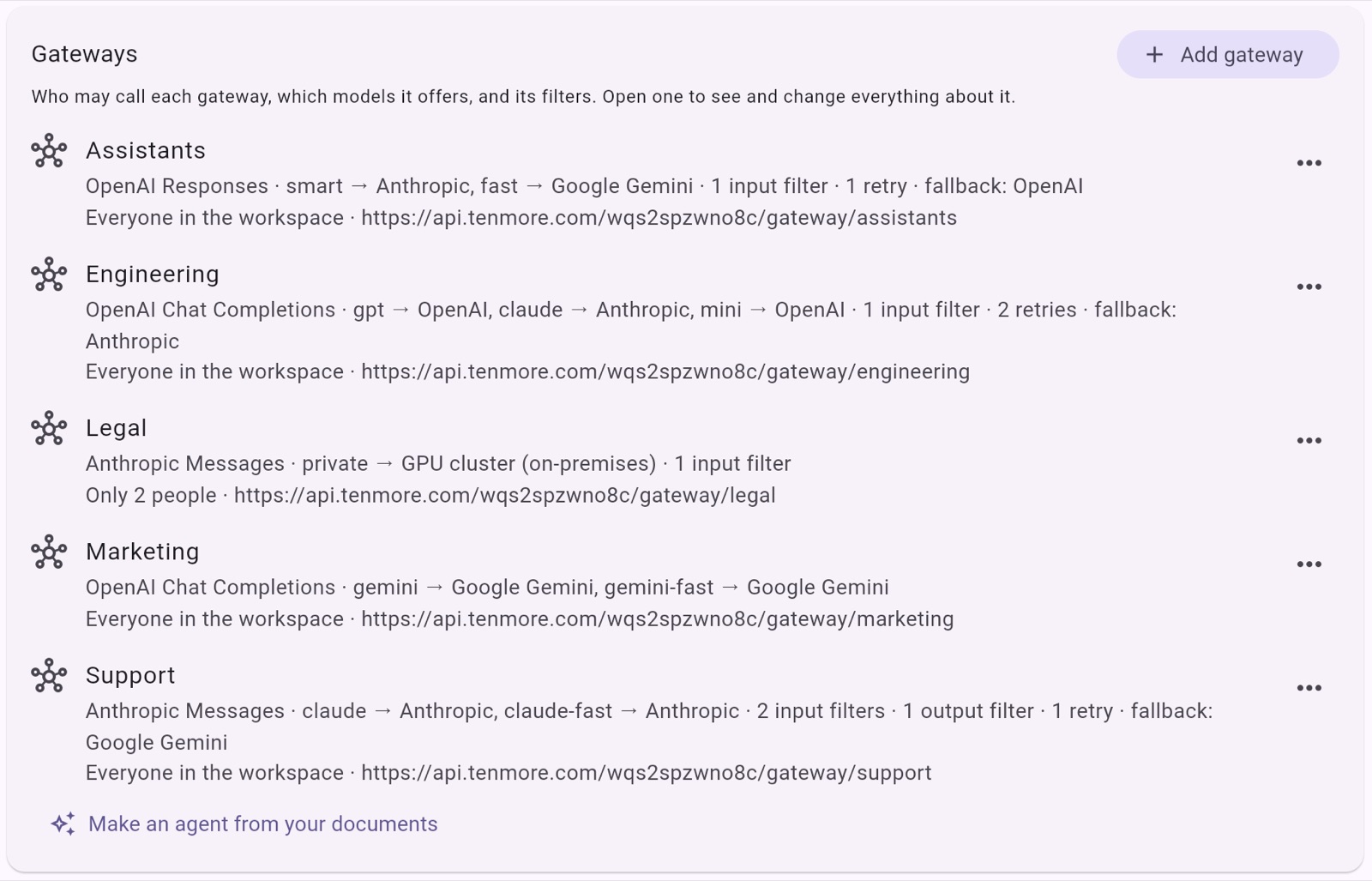
Tenmore Gate is the single, governed entry point to every AI model your company uses. IT decides who uses which models, sensitive data stays inside, changes are tested before they reach everyone, and every dollar is accounted for. Agents built from your teams’ documents are managed the same way. Run it in our cloud or inside your own network.
Teams adopt AI faster than policy can follow. The result is the same three risks in almost every organization.
People sign up for AI tools on their own, share provider keys between teams, and build assistants on personal accounts with company documents. Nobody can say who has access to what, or take it back when someone leaves.
Customer records, contracts and credentials get pasted into prompts and sent to outside providers, with no record that it happened.
AI bills arrive as a few large numbers on several invoices. Finance can't tell which team, project or person they belong to.
Give a team an agent that knows its handbook, price list or runbook. Tenmore Gate builds it from the team’s documents and tests it against them before anyone uses it. From then on it’s managed like any gateway: admins decide who may use it, every change is versioned, and it runs on approved models with the same filters, redaction, cost tracking and audit log.
What it knows
Example: an agent built from an HR handbook.
Make an agent public and it answers visitors on your website, from public information only. It has its own spending cap and usage limits, can’t reach company tools, tells every visitor it’s an AI, and switches off at once. The assistant on this page runs on Tenmore Gate.
Describe what shouldn't leave the company. Tenmore Gate turns your description into a set of narrow yes/no questions and asks a fast decision model about every request. Narrow questions are far more accurate than one broad instruction, and you never have to write them.
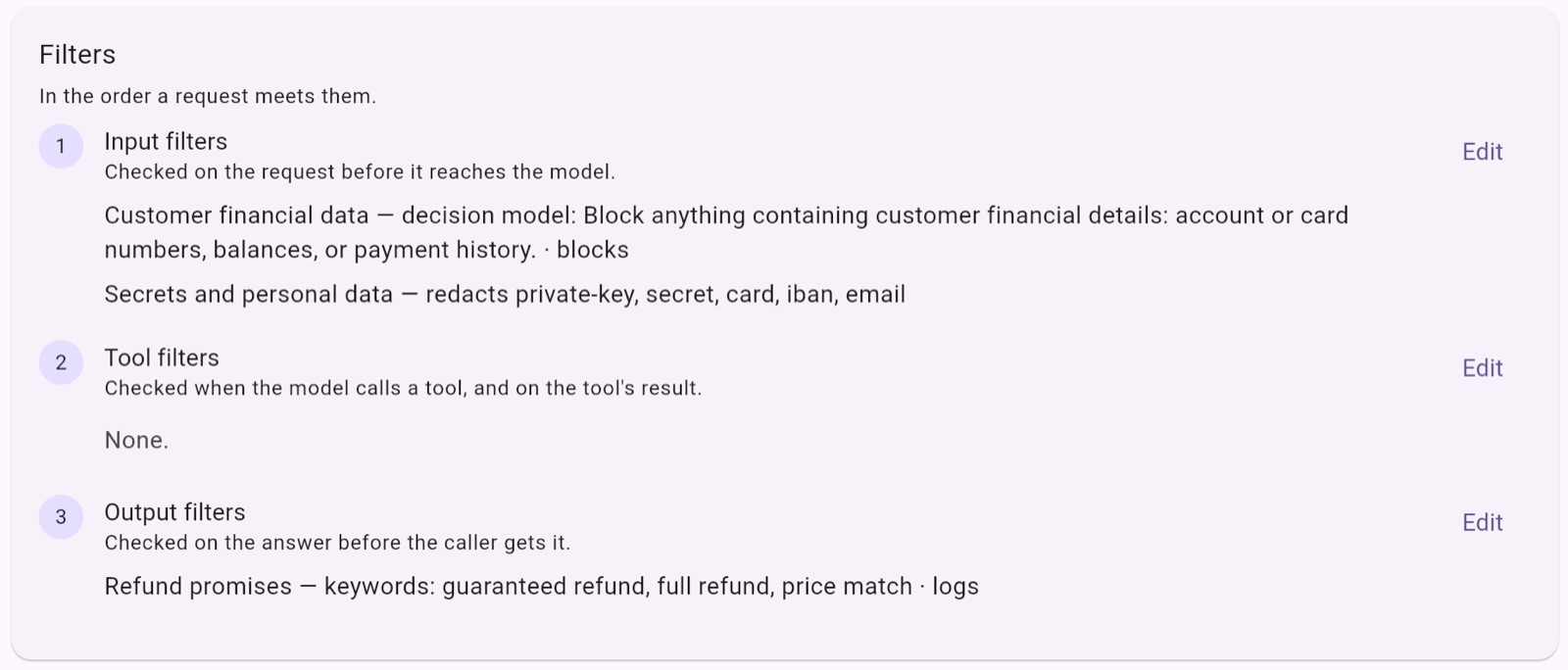
When blocking is too blunt, Tenmore Gate replaces the value and lets the request through. It works on prompts before the model sees them, on answers before your people read them, and on tool results before they reach the model.
Add MCP servers to a gateway and Tenmore Gate runs their tools itself. The model provider never sees the server's address or credentials, and your servers don't need to be on the internet. Every call is checked before it runs, and every result before the model reads it.
Example: one agent request.
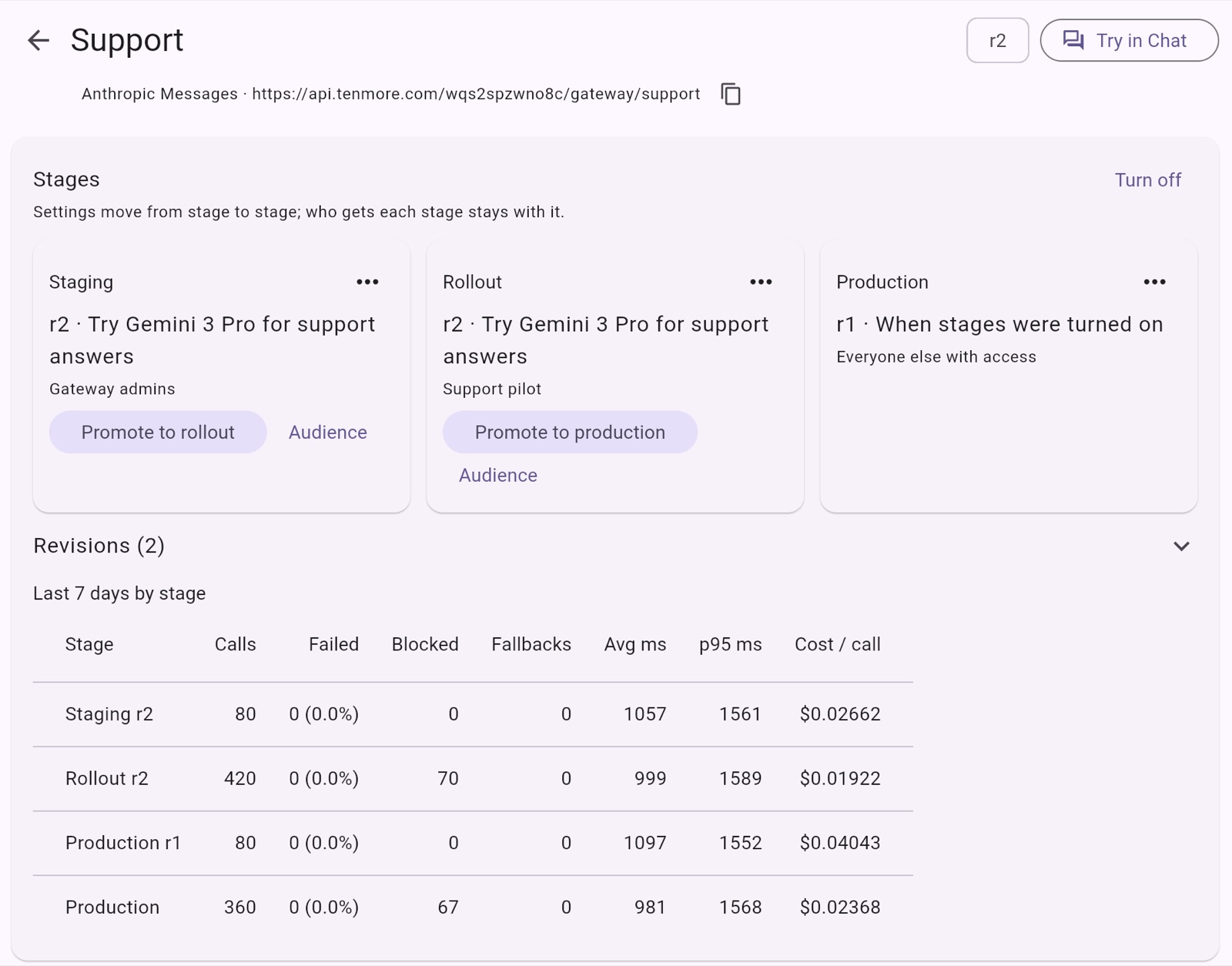
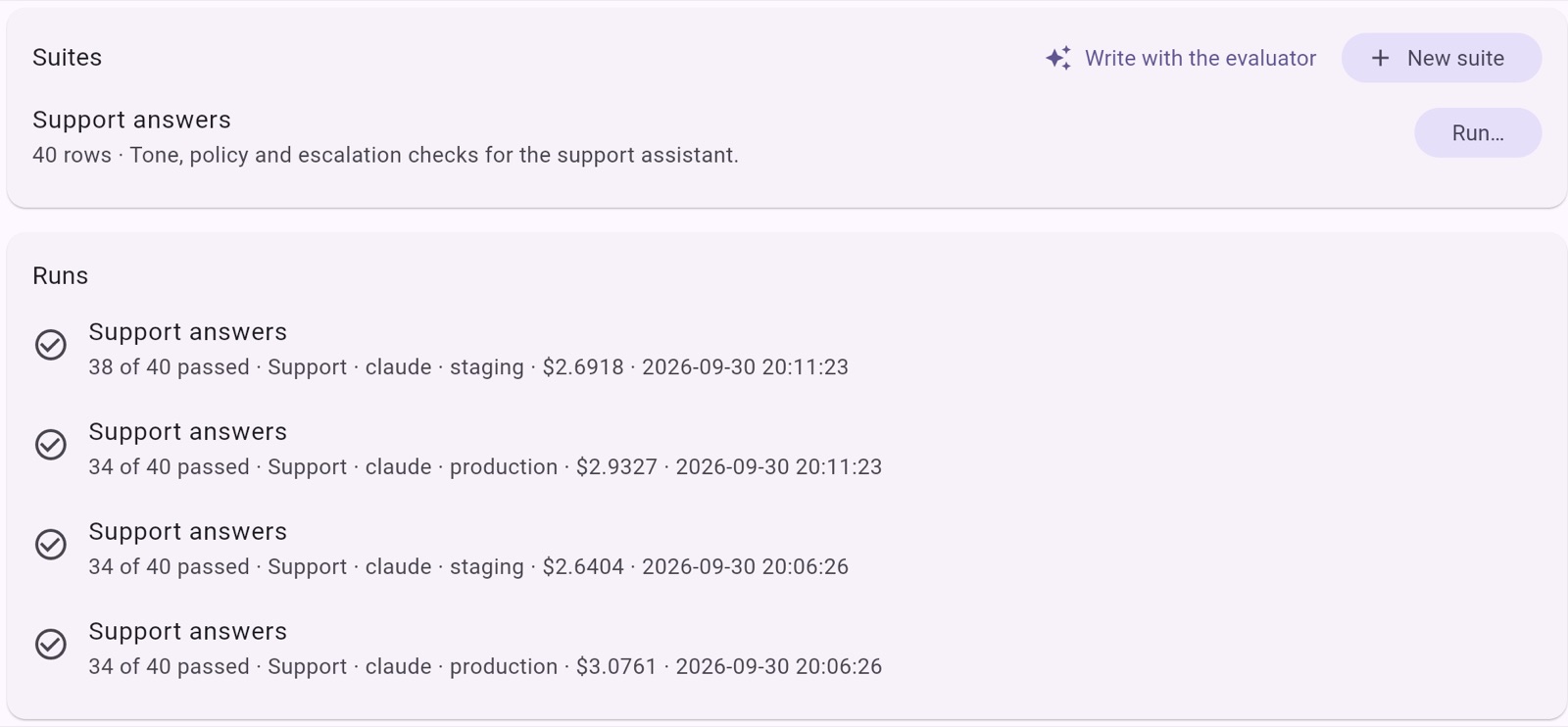
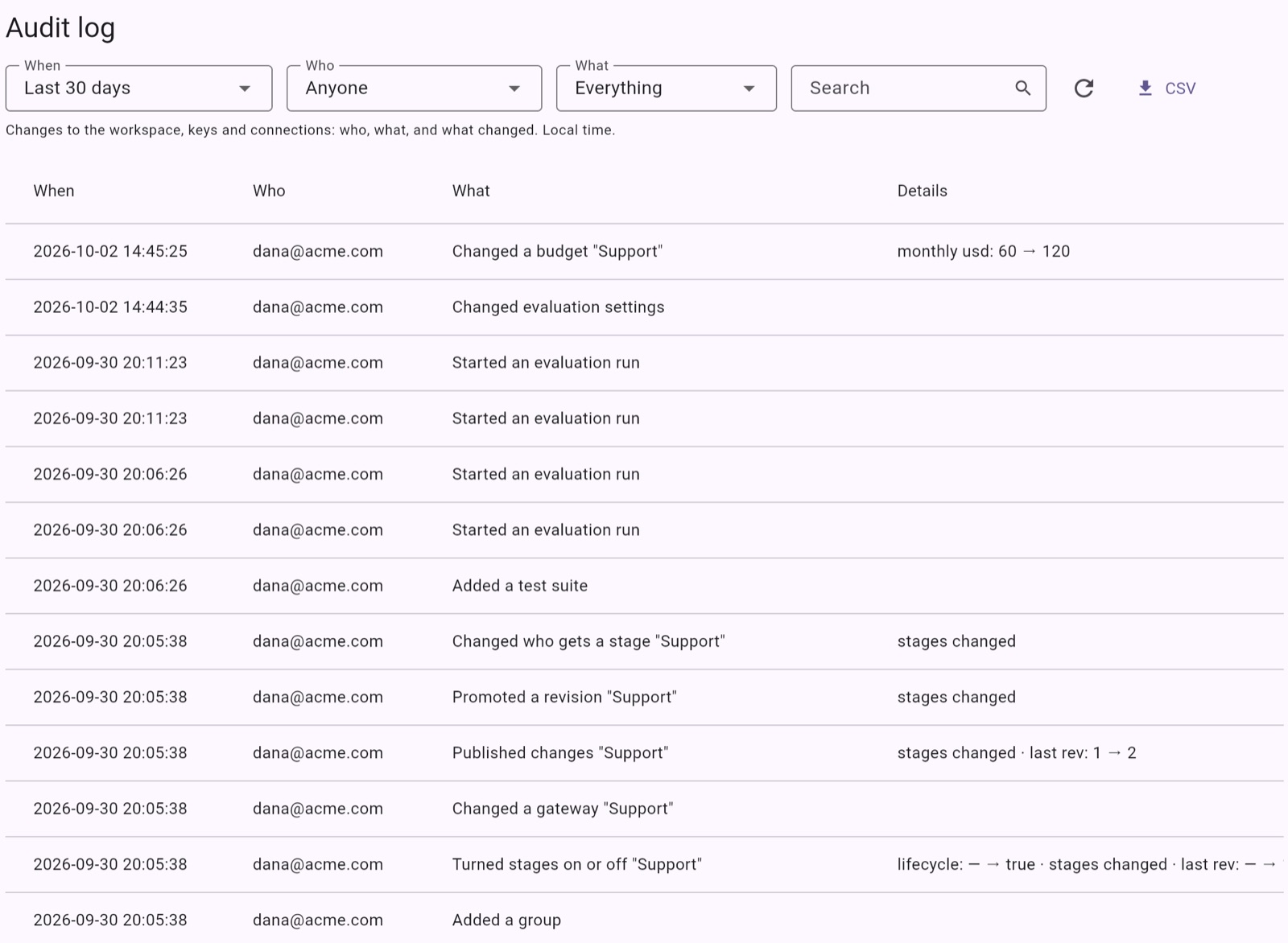
A new model, a stricter policy or a new tool can change what hundreds of people get back. In Tenmore Gate, every change to a gateway is a new version. Test it, release it to a pilot group, compare, then promote it to everyone, with each step in the audit log.
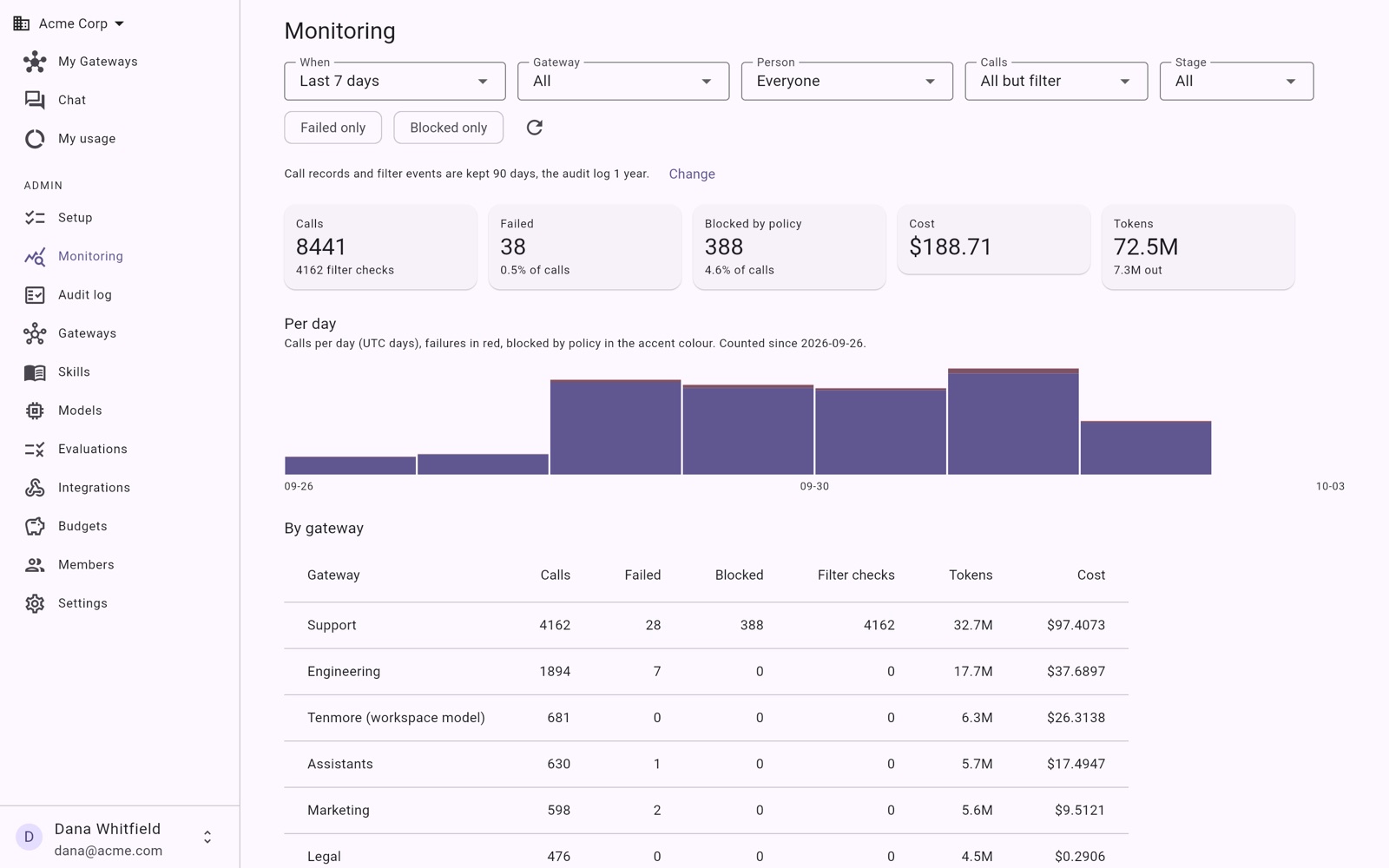
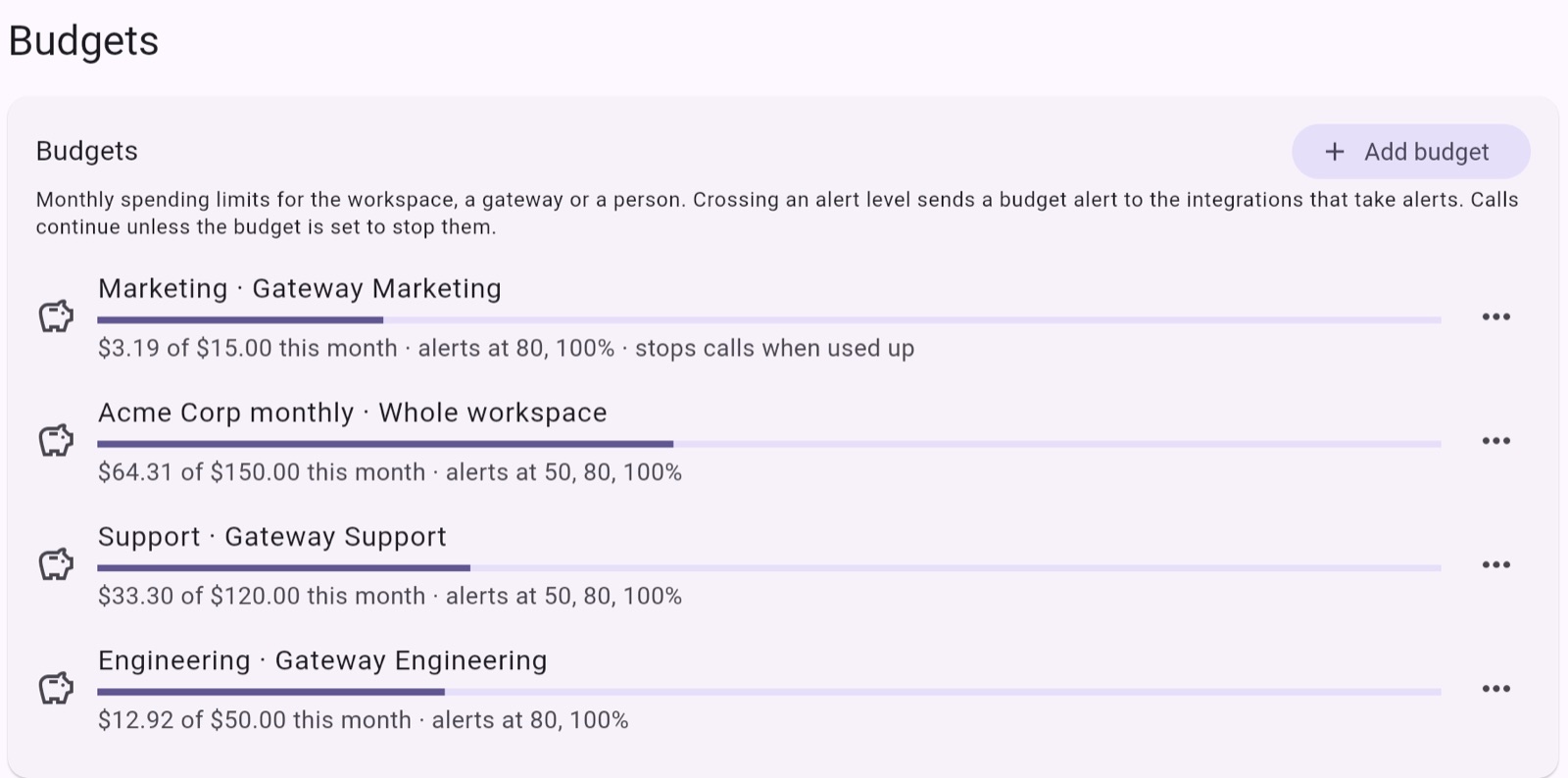
Tenmore Gate records tokens and cost on every call, with monthly totals per person and per gateway. Prices for common models are filled in for you.
Tenmore Gate isn't tied to any provider. It connects directly to the major clouds and model makers, to any service with an OpenAI- or Anthropic-compatible API, and to models on your own servers. Every one of them gets the same access rules, policies, redaction and cost tracking.
Any service with an OpenAI- or Anthropic-compatible API, for example:
Open-weight models on hardware you control, inside your network:
Tenmore Gate ships as a container. Run it inside your network with your own database, and point it at models you host yourself. Prompts, answers, tool calls and policy checks can all stay on hardware you control.
Example setup.
Tenmore Gate sends what it sees to your SIEM, your observability platform and your alerting tools, as it happens. Prompts and answers are never included, only who, what, when and the outcome.
Existing apps and tools keep working: developers change one URL and use a personal key. Tenmore Gate translates between API formats, so an app written for one provider can use a model from another, and callers can't reach a model you didn't approve.
from openai import OpenAI

client = OpenAI(
    base_url="https://api.tenmore.com/acme/gateway/assistants",
    api_key="tmgw_…",  # your personal gateway key
)

reply = client.responses.create(
    model="smart",  # a name your admin chose
    input="Summarize the attached contract.",
)
from anthropic import Anthropic

client = Anthropic(
    base_url="https://api.tenmore.com/acme/gateway/claude",
    api_key="tmgw_…",
)

message = client.messages.create(
    model="smart",
    max_tokens=1024,
    messages=[{"role": "user", "content": "Draft the release notes."}],
)
curl https://api.tenmore.com/acme/gateway/assistants/chat/completions \
  -H "Authorization: Bearer tmgw_…" \
  -H "Content-Type: application/json" \
  -d '{"model": "fast", "stream": true,
       "messages": [{"role": "user", "content": "Hello"}]}'
In a typical 2-second call, about 10 ms is Tenmore Gate; the rest is the model.
Medians measured 2026-10-01 on AWS, at low load; cold starts excluded. Measure your own gateways with the Filter latency button on any gateway's page.
Every call passes the same checks, in the same order, whichever model answers. This is one example request, step by step.
Example request. Names, prices and scores are illustrative.
Tenmore Gate sees every request, so it's designed to remember as little as possible.
Tenmore Gate records which policy acted, for whom and when, with a score or count. Never the text of a user’s prompt or its answer.
Every policy decision and every admin change, with before and after values, kept as long as you choose and exported to your SIEM.
Single sign-on and automatic provisioning with Microsoft Entra ID, or passwords with two-step verification. Sign-ins are logged.
Encrypted at rest and never shown again, not even to admins. People use personal gateway keys you can revoke at any time.
People and apps can only reach the models IT approved for them.
Use our cloud, or self-host Tenmore Gate as a container next to internal models and tools. Nothing has to touch the public internet.
Most LLM proxies route traffic and count tokens. Tenmore Gate governs it.
| Capability | Typical LLM proxy | Tenmore Gate |
|---|---|---|
| One endpoint for several providers | ✓ | ✓ |
| Cost tracking | Per key, user or team | Per person and gateway |
| Access by person, with allow and deny lists | Some | ✓ |
| Policies written in plain English | — | ✓ |
| Agents built from your documents, under the same rules | — | ✓ |
| Public agents for your website, with spending caps and limits per visitor | — | ✓ |
| Decision-model filters with tunable thresholds | Rare | ✓ |
| Redaction on streamed answers and tool results | Rare | ✓ |
| Runs MCP tools itself, with per-person sign-in | Some | ✓ |
| Tool rules that block a call before it runs | Some | ✓ |
| Translation between provider API formats | Common | ✓ |
| Self-hosted behind your firewall, with local models and local policy checks | Some | ✓ |
| Staged rollouts and evaluations for model and policy changes | Rare | ✓ |
| Audit log of admin changes, exported to Splunk or Sentinel | Some | ✓ |
| Budgets with alerts and hard limits | Common | ✓ |
| User prompts never stored | Varies | ✓ |
Five situations most organizations meet as AI spreads, from the person responsible to the result.
Try Tenmore Gate with your own models and teams, ask us anything about it, or write to us and a human will reply.